The Fine Gets Paid. The Record Doesn’t Go Away.
When a manufacturing facility gets cited by OSHA, the fine is the number everyone focuses on. It is concrete, it is immediate, and it demands attention. But the financial penalty is actually the most temporary part of what happens when citations are issued.
The fine gets paid. The violations get corrected. The business moves on. The record, however, does not.
What OSHA Actually Does After They Cite You
Most owners understand that an OSHA citation comes with a fine. What fewer realize is what else happens the moment those citations are issued. OSHA publishes a press release every time. For every citation that meets their threshold, they put out a formal public statement that names the company, describes the violations, lists the penalties, and includes a statement about the failure to protect workers.
That press release goes out to the media. Local papers pick it up. Trade publications pick it up. Industry outlets pick it up. And once it is out there, it lives online permanently. There is no correction. There is no expiration. There is no way to have it removed. It becomes a permanent part of a company’s public record, searchable by anyone with a browser.
Who Is Actually Reading Those Press Releases
This is where the real damage happens, and it is broader than most people assume. Here is who typically finds a public OSHA citation record:
- Prospective customers doing due diligence before signing a contract or adding you to their vendor list
- Existing customers whose procurement teams run periodic vendor audits
- Job candidates researching your company before accepting an offer
- Competitors who may reference it in competitive situations
- Your own employees, who share things they find online
- Insurance carriers reviewing your risk profile at renewal time
Keep in mind, these people are not necessarily going looking for it. They are searching a company name for normal reasons, and it shows up. The citation record does not announce itself as old news. It just sits there alongside everything else about the business.
Texas manufacturers have reported prospective customers bringing up years-old OSHA citations during vendor qualification conversations. The manufacturer thought it was ancient history. The customer found it in three minutes online and treated it as current information about how the company operates.
The Timeline Problem: Citations Do Not Age the Way You Think They Do
One of the most common things heard from owners who have been through a citation is some version of “that was three years ago, we fixed everything.” And they did. But the public record does not reflect that. OSHA’s enforcement database and the press releases tied to it do not update themselves to show that violations were corrected or that fines were paid. They show what happened. Period.
For manufacturers in Texas, this compounds quickly because OSHA is not the only agency with public enforcement records. TCEQ and EPA both maintain public enforcement histories as well. A company that has had action from multiple agencies has multiple records sitting online, each one creating its own reputational footprint.
The practical result is that the reputation cost of a citation often outlasts the operational disruption by years. The company moves on. The record does not. Understanding whether to contest OSHA citations is one piece of managing this, but the better play is building a program where leadership accountability is strong enough to prevent citations from happening in the first place.
| How clearly is accountability defined at your leadership level?
Berg’s Manufacturing Leader’s Safety Accountability Assessment is a free 2-minute diagnostic that shows where accountability is clearly owned, where expectations are assumed rather than defined, and where leadership behaviors may be creating unintended exposure. |
What a Citation Actually Costs Beyond the Fine
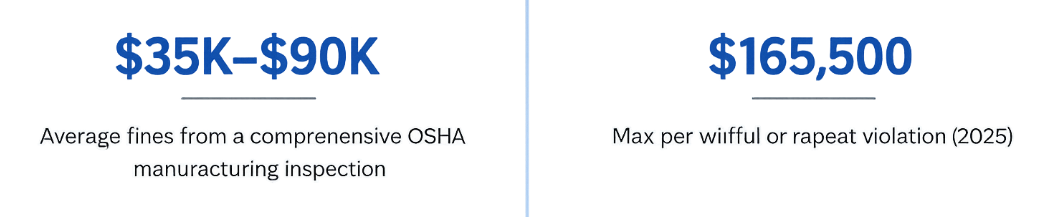
The fine is the number everyone fixates on, and understandably so. The average comprehensive OSHA inspection of a manufacturing facility results in $35,000 to $90,000 in fines, and that number can go higher. But the reputational costs that compound on top of that are harder to quantify and often larger in total.
Beyond the fine itself: a customer who finds the citation record and quietly moves their business elsewhere. A strong job candidate who sees it and takes a different offer. A vendor relationship that does not get renewed because a procurement team flagged the compliance history. An insurance renewal that comes in at a higher premium because the risk profile now includes enforcement history. None of these show up as line items. All of them are real.
Companies do recover from citations. But the recovery is faster and cleaner when it is handled the right way from the start. If a citation is active right now, understanding how to manage an active OSHA inspection is critical to limiting the damage and setting up the best possible outcome.
The Root Cause Is Almost Always a Leadership Decision
The citations that end up in the public record are rarely the result of a single bad day on the floor. They are the result of compliance gaps that existed for a period of time, were not caught or prioritized, and surfaced when an inspector showed up. That pattern traces back to the same place in almost every case: a leadership decision, or the absence of one, about who owns safety compliance and what it is worth.
The manufacturers in Texas who are not showing up in OSHA’s enforcement database are not necessarily bigger, better funded, or more sophisticated. They have made a decision to build programs that actually work, document what they are doing, and hold leadership accountable for maintaining it. That decision is available to any owner willing to make it.
A Texas machine shop came to Berg after receiving OSHA citations that had already made it into the public record. They corrected every violation before the deadline, qualified for OSHA’s expedited settlement program for reduced fines, and achieved full compliance within months. The citations still exist in the public record. But what came after them tells a different story to anyone who looks.
The best time to build a program that keeps a facility out of the enforcement database is before an inspection. The second best time is right now. Understanding how to prepare for an OSHA inspection provides the framework, and the assessment below gives you a clear picture of where leadership accountability stands today.
| “Berg Compliance Solutions went over and above in helping us through a recent OSHA enforcement investigation. Their support was instrumental in allowing us to prevent many citations, eliminate others, and greatly reduce our fines. And now they are already helping us correct the problems to make sure they do not happen again.”
— Third-Party Business Consultant, Texas Manufacturing |
| If there has been a citation, if an inspection is coming, or if you simply do not know how your program would hold up if OSHA walked in tomorrow, a free strategy call is a no-pressure conversation about your current situation and what it would take to get your program where it needs to be. |
Related Reading
Should you contest OSHA citations?
How to prepare for an OSHA inspection