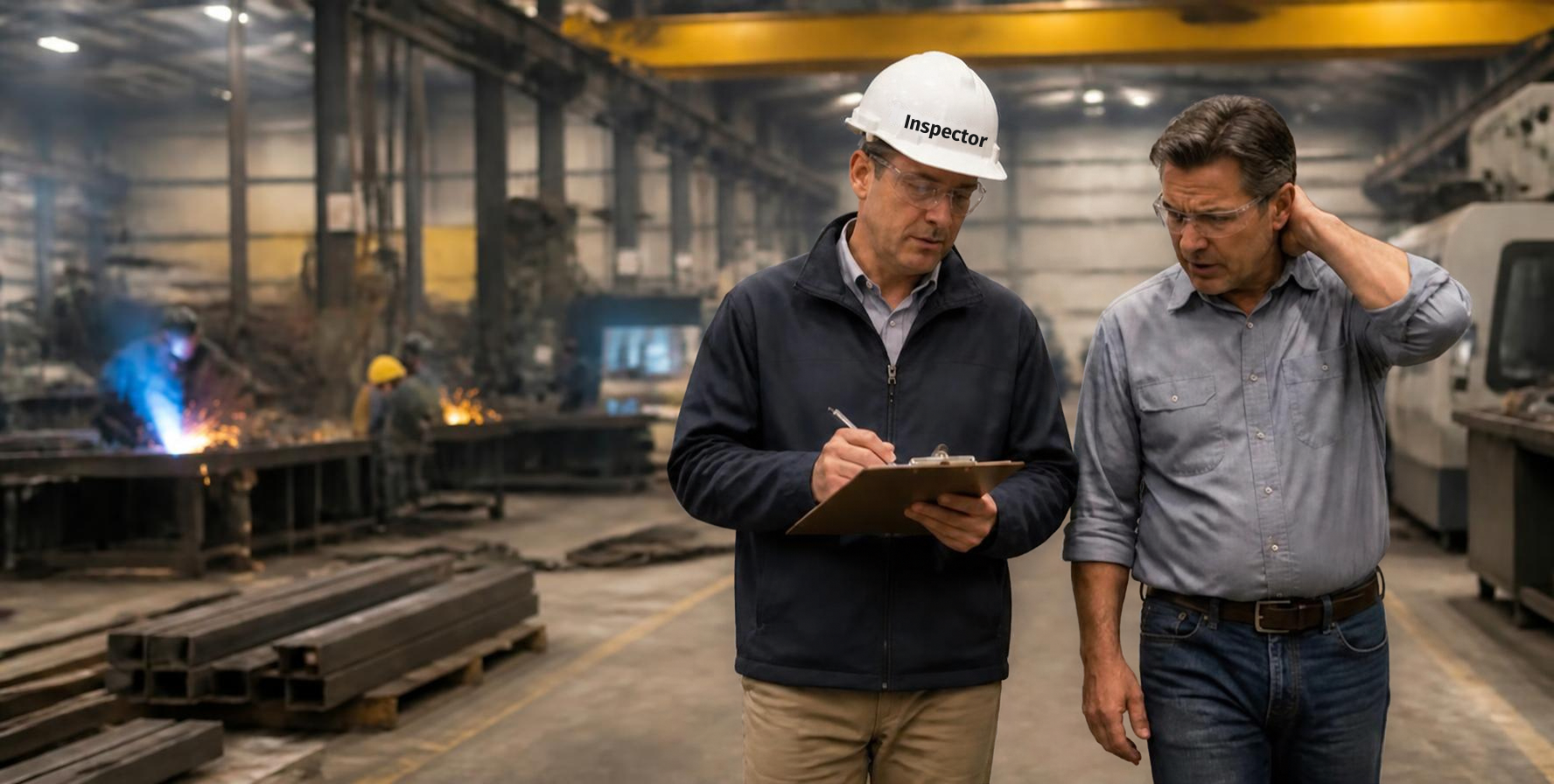
If OSHA showed up at your manufacturing facility tomorrow morning with no warning, would your safety program hold up, or would you be scrambling? Most owners I talk to assume the answer is yes, right up until they run an honest safety program self-assessment and actually see what an inspector checks line by line. Here are seven questions, the same ones I use with manufacturers every week, that will tell you the truth before a surprise inspection does.
Here’s the thing. “We’ve never had a fine” and “we’d pass an audit” are two completely different statements, and I’ve watched good owners confuse them for years. I did it myself, believe me when I tell you. I ran a business before I ever got into compliance work, and I failed a surprise OSHA inspection I was sure I’d pass. I wasn’t cutting corners either, I’d spent real money on safety. I just didn’t know what I didn’t know.
A comprehensive OSHA inspection of a manufacturing facility typically results in $35,000 to $90,000 in fines, and it can run well past $100,000 once willful or repeat violations get added in. Serious violations alone can carry a maximum penalty of $16,500 each, and those jump to $165,500 each for willful or repeat findings. That’s before you count the lost production time, the lawyer, and the contract you don’t win because you can’t produce a documented program when a customer asks for one.
The good news is you don’t need a guess. A short, honest safety program self-assessment, the kind I’ll walk through below, tells you in about ten minutes where you actually stand, not where you hope you stand.
If you want a more structured version of this self-assessment, our Safety-Driven Operational Resilience ROI Calculator walks through how your current program affects downtime, production stability, and the bottom line, not just whether you’d pass an inspection.
A Safety Program Self-Assessment for Manufacturers Starts Here: Real Program, or Binder on a Shelf?
A real safety program is written, specific to your facility’s actual hazards, and something your employees can explain back in their own words. A binder is generic, bought off the internet, and opened for the first time when an inspector asks to see it.
This is the mistake I see most often, and I made a version of it myself. A 225-page manual that was never customized to your equipment, your chemicals, or your floor layout does not pass an inspection, because OSHA doesn’t just check whether a document exists, they check whether your people actually understand and follow it. “Tailgate talks” and a sign-off sheet don’t meet that bar either. If you want the step-by-step version of what a real program looks like, I walked through it in how to build a manufacturing safety program.
Here’s the second part of this same question: can your floor supervisor, not just your safety manager, tell an inspector why a specific procedure exists? If the honest answer is “probably not,” that’s a gap worth closing before someone in a government vehicle finds it for you.
Who Actually Owns Safety at Your Company?
If the honest answer is “whoever has time,” that’s your gap, not a people problem. I see this constantly: a plant manager, an HR coordinator, or an operations director gets safety added to an already full plate, with no additional hours in the day to do it right. That’s not a reflection on them, it’s a structural problem with how the role gets set up in the first place.
The research backs this up. Vetting a safety hire is genuinely hard if you’ve never hired for the role yourself, book knowledge doesn’t always translate into running a real program day to day, and most candidates are strong in either safety or environmental, rarely both, even though almost every manufacturer needs both. None of that means dual-tasking it onto someone else is working either. It usually just means nobody’s watching the whole board.
Here’s the number that usually gets an owner’s attention: a full-time, qualified safety manager runs $175,000 to $250,000 a year in salary alone, and that’s before you factor in the learning curve and the fact that most candidates are strong in either safety or environmental, rarely both. I’m not saying don’t hire. I’m saying know what you’re actually comparing before you decide dual-tasking, a single hire, or a partnership is the right structure for where your company is right now.
Are You Covered on OSHA, But Blind on Environmental?
Most manufacturers I talk to have thought about OSHA. Far fewer have thought about the Texas Commission on Environmental Quality, hazardous waste manifesting, stormwater, or air permits, until something trips a wire they didn’t know was there.
I ran into this exact blind spot myself. I thought I had safety handled, and I still walked into unexpected trouble with TCEQ, not because I was negligent, but because I genuinely didn’t know what I didn’t know. Environmental requirements don’t show up on an OSHA checklist, and a workers’ comp carrier or a generalist firm checking boxes almost never covers them either. If your facility generates waste, discharges stormwater, or holds an air permit, it’s worth reading common Texas environmental compliance requirements before you assume you’re covered.
Keep in mind, your insurance doesn’t close this gap either. A general liability or workers’ comp policy covers some of the financial fallout after something goes wrong, it doesn’t prevent a citation, pay a regulatory fine, or stop a customer from walking away after a public enforcement action. I’ve known business owners, personally, who found that out the hard way, including real fines and in one case I’m aware of, actual jail time. I’m not telling you that to scare you, I’m telling you because it’s real, and because a self-assessment is a much cheaper way to find out where you stand.
Could You Produce the Paperwork Today, If Someone Asked?
If an inspector, or a customer, asked for your OSHA 300 logs and training records this afternoon, could you hand them over in minutes, or would you be digging through email and a filing cabinet? Recordkeeping gaps are one of the fastest ways a routine visit turns into a longer one.
This matters for more than OSHA. Larger customers increasingly require proof of a documented safety program, and sometimes certifications like ISO 45001 or ISO 14001, before they’ll award a contract, and most small manufacturers don’t find out until a bid specifically asks for it. I’ve seen owners lose real business this way, not because their safety was actually bad, but because they couldn’t produce the proof fast enough. If recordkeeping and injury metrics are new territory for you, OSHA 300 log requirements is a good next read, and if you want to get ahead of an actual visit instead of reacting to one, how to prepare for an OSHA inspection walks through it step by step.
“I’ve had the pleasure of working with Berg Compliance Solutions to shore up our confidence in our compliance. As a small company we can’t dedicate a resource to becoming an expert in this field, so partnering with Berg in this capacity has been fantastic. They have driven our compliance schedule and audits to ensure we have a safe workplace for our employees. Everyone we have engaged within Berg has been a very personable and competent individual with great leadership.” Kit Harper, Plant Manager, Lifelast
Frequently Asked Questions
How do I know if my safety program would survive an OSHA audit?
Run through whether you have a written, site-specific program, clear ownership of safety, environmental requirements covered alongside OSHA, and records you can produce quickly. If any of those four feel shaky, a formal self-assessment or outside review will show you exactly where before a real inspector does.
What’s the difference between a safety manual and a safety program?
A manual is a document. A program is the manual plus training employees can explain back, routine inspections, and records that prove it’s actually being followed day to day. OSHA inspectors are checking for the program, not just whether paperwork exists in a drawer somewhere.
Do I need to worry about environmental compliance if OSHA has never cited us?
Yes. OSHA and TCEQ are separate agencies covering separate requirements, including hazardous waste, stormwater, and air permits, and a clean OSHA history tells you nothing about your environmental exposure. Many manufacturers only discover the gap when a permit renewal or an inspection catches them by surprise.
How much does a failed OSHA inspection actually cost?
A comprehensive inspection of a manufacturing facility typically results in $35,000 to $90,000 in fines, and can exceed $100,000 with willful or repeat violations added in. That figure doesn’t include lost production time, legal costs, or contracts lost because you couldn’t show a documented program.
Is a self-assessment enough, or do I need an outside audit?
A self-assessment is a strong starting point and will surface the obvious gaps, but it’s hard to see your own blind spots from the inside, which is exactly how most owners end up with unexpected findings. An outside, structured review catches what internal familiarity tends to miss.
Ready to See Where You Actually Stand?
If any of those seven questions made you a little uneasy, you’re not alone, and that feeling is exactly why I started this company. I’m not asking you to do anything I haven’t already done myself, I spent tens of thousands of dollars finding my own gaps the hard way. If you’d rather find yours on a short phone call instead, I’m glad to talk it through. No pitch, no obligation, just an honest conversation about where your operation actually stands. You can book a free consultation here, and we’ll figure out together what, if anything, needs attention.