Why Most Manufacturers Tackle OSHA Inspection Readiness in the Wrong Order
OSHA inspection readiness is achievable for every manufacturing facility in Texas. The path is clear. What it requires is doing the right things in the right order and knowing what complete readiness looks like when you get there.
Believe me when I tell you that “achievable” does not mean “automatic.” Most facilities that struggle do not fail because they lack effort. Instead, the problem is almost always sequence. Companies work in the wrong areas first, or skip steps entirely. Here is the proven path that works.
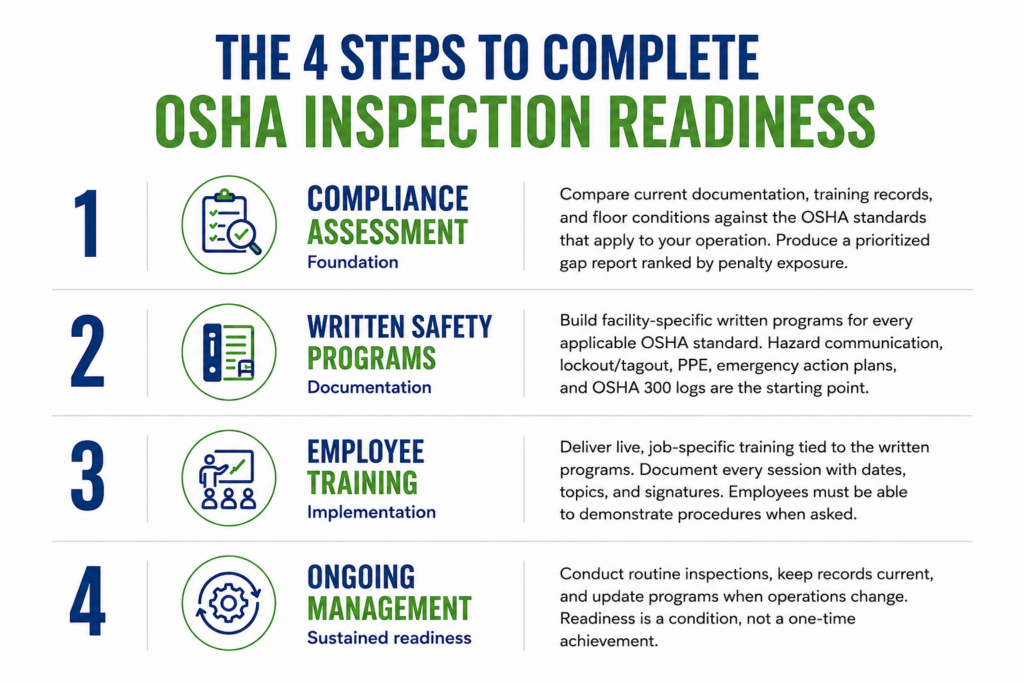
Step 1: Start with an Honest OSHA Inspection Readiness Assessment
The most important step on this path is also the one most manufacturers skip. That step is a systematic look at the current condition of the safety program against OSHA’s actual standards.
Not a gut check. Not a scan of the binder. A real assessment compares current documentation, training records, and physical floor conditions against the specific standards that apply to the operation. In fact, most manufacturers who think they are reasonably compliant discover real gaps during this process. Hazard communication programs that have drifted out of date. Lockout/tagout procedures that no longer match current equipment. Training records that staff cannot locate.
A compliance assessment is not a judgment. It is the foundation. You cannot build a reliable safety program on top of assumptions about where you stand.
The assessment output becomes the roadmap for everything that follows. For a closer look at what OSHA evaluates, this overview of what an OSHA inspection involves is worth reading first.
Step 2: Build Written Safety Programs That Support OSHA Inspection Readiness
Once the gaps are clear, the next step is documentation. Written safety programs must be specific to the facility. Generic templates filed away and forgotten do not satisfy OSHA’s requirements.
OSHA requires employers to assess their specific operations, identify actual hazards, and build programs that address them directly. Key programs for most manufacturers include hazard communication, lockout/tagout, PPE, emergency action plans, and OSHA 300 log recordkeeping. As a result, the list often runs longer than most owners expect once a real assessment is complete.
Keep in mind: written programs are the foundation, not the finish line. A program employees have never seen is a liability, not an asset. For a full breakdown of what a properly built program requires, this guide to building a manufacturing safety program covers the core components.
Step 3: Train Employees the Right Way and Document Every Session
This is where more manufacturers fall short than any other step. Generic online training videos produce completion certificates. What they do not produce is an employee who can demonstrate a lockout/tagout procedure when an OSHA inspector asks.
OSHA’s training requirements are specific. Training must cover the actual hazards at that facility. Employees must genuinely understand it. And someone must verify that they do. Generic platforms rarely meet that standard for manufacturing operations.
What OSHA inspectors actually look for in training records
Inspectors pull training records and ask straightforward questions: Who was trained? On what standard? When? Complete records tied to facility-specific programs help the inspection move quickly. So when records are missing or reference generic online modules with no connection to the actual operation, inspectors flag it.
Beyond records, inspectors conduct private employee interviews and ask staff to demonstrate procedures. Those answers come directly from training. OSHA’s training requirements for manufacturers spell out exactly what the standard requires for each one.
Not sure where your facility stands on training documentation or program completeness?
The free OSHA Inspection Readiness Assessment takes two minutes and returns a custom readiness score plus a breakdown of the biggest gaps.
Step 4: Maintain the Program So Readiness Holds
This final step separates manufacturers who pass inspections from those who scramble. A safety program that reaches full compliance and then sits untouched will drift. Over time, operations change and equipment gets added. Employees turn over and bring training gaps with them. Because of this, each of those events can open a gap between the written program and actual conditions on the floor.
My point is, readiness is a condition, not an event. Facilities that handle OSHA inspections with confidence manage safety consistently. Routine inspections. Current records. Programs that reflect today’s operations. A clear process for employees to report hazards and get a documented response.
“Berg Compliance Solutions took control of our safety program and took the burden off our shoulders with minimal work or disruption on our end. They wrote our manual, developed our procedures, trained our employees. Everything was done on time and professionally.”
— Owner, Specialty Machine Shop · Texas
A Texas machine shop came to Berg after receiving OSHA citations with a short deadline to correct them. Berg built a prioritized action plan and resolved every citation before the deadline. The company also qualified for OSHA’s expedited settlement program for reduced fines. That contract has been renewed every year since. The good news is that result is available to any facility that commits to the process.
Your Next Step Toward Complete OSHA Inspection Readiness
A facility with real OSHA inspection readiness can answer yes to four questions at any time. Do written programs reflect current operations? Do training records show live, facility-specific instruction? Are those records accessible? Does the facility actively identify hazards, correct them, and document the fix?
In short, when the answer to all four is yes, a surprise inspection is not a crisis. For more on the process itself, this guide on preparing for an OSHA inspection and this one on managing an inspection in real time are the logical next reads.
The path to complete OSHA inspection readiness is clear. A free strategy call is the place to find out whether the right people and processes are in place to walk it. No pitch, no pressure.